

Impossibility Proofs tell you that building certain shapes is not possible. This knowledge prevents wasting your time on attempting to build impossible shapes. Furthermore, you will learn two important mathematical concepts - the necessary and sufficient conditions.

Knowing how to record your constructs is important in reaching your goal - building the cube in 240 ways and constructing other shapes. Here, you will learn how to represent your constructs in a number grid in both decimal and binary systems and the cartesian coordinate system.


Can you make any shape with Soma blocks?
NO, you can’t make every shape. You can make only certain shapes with two or more Soma blocks.
So, can you tell in advance that building certain shapes is not possible?. In other words, is there a way to check the possibility of any build before attempting to actually build it?
Yes. you can tell it using some mathematical principles.This section teaches you these mathematical principles. These are known as Impossibility Proofs. We can only say building a particular shape is impossible.
We never say building a particular shape is possible.Mainly there are two techniques:- Counting Techniques and Coloring Techniques.
Mainly there are two techniques:- Counting Techniques and Coloring Techniques.
This is the simplest technique. It is based on the number of unit cubes in a given shape.
Try to build the formation on your right.
This formation has 6 surfaces, with each surface containing 9 unit cubes. There is no hole or cavity in this formation.
A careful count of the unit cubes will show you that the above formation is made up with 28 unit cubes. However, the Soma set has only 27 unit cubes. Therefore, it is not possible to build a formation which requires 28 unit cubes as a Soma set has only 27 unit cubes.

Let's do some practice activities.
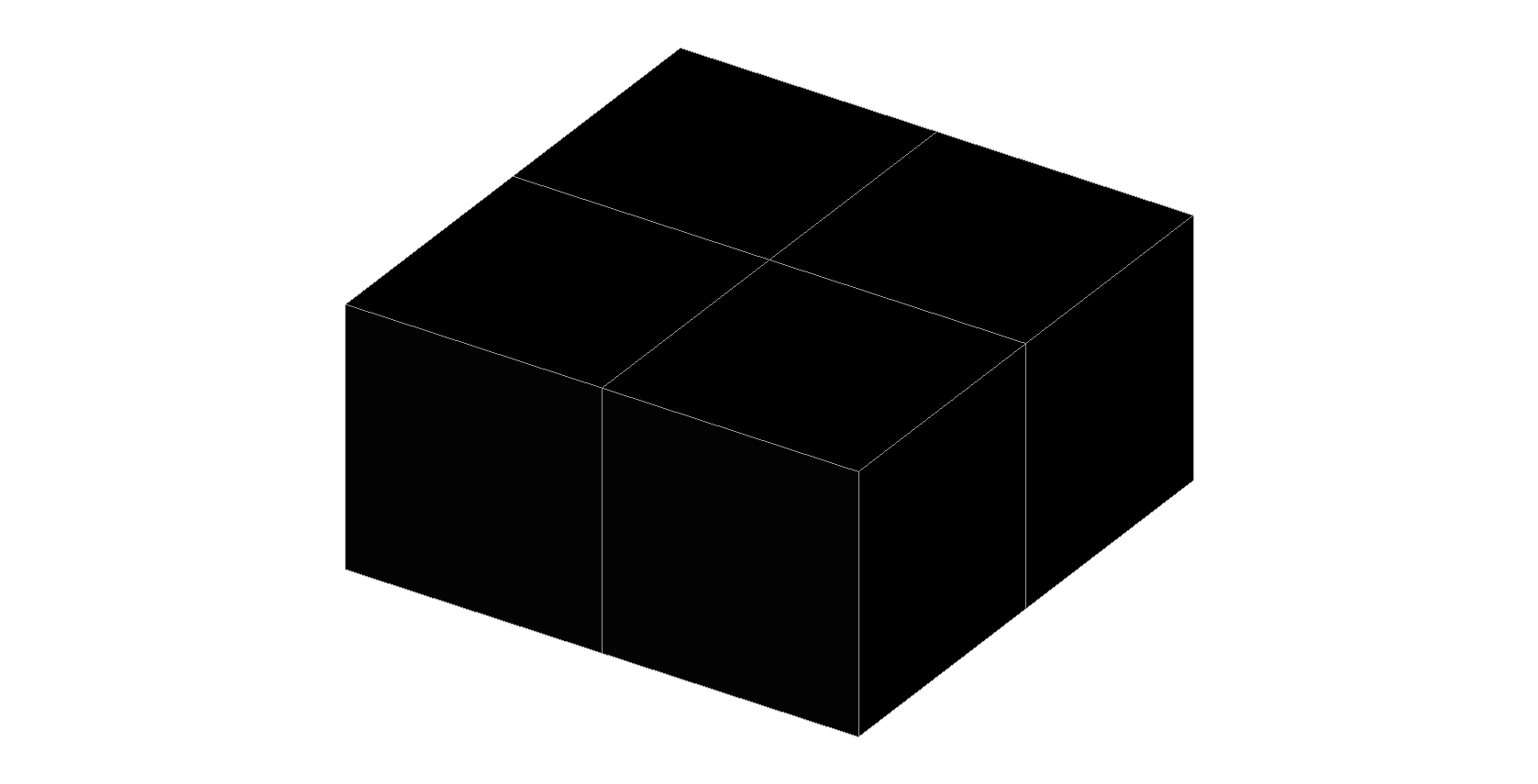
No. It is impossible to build this shape.
Even though, there are six Soma blocks with four unit cubes, none of these have the form given in the above picture.
The other option is building it with a block that has 3 unit cubes. However, there is no block with one unit cube in the Soma set.
Therefore, it is impossible to build the given shape.
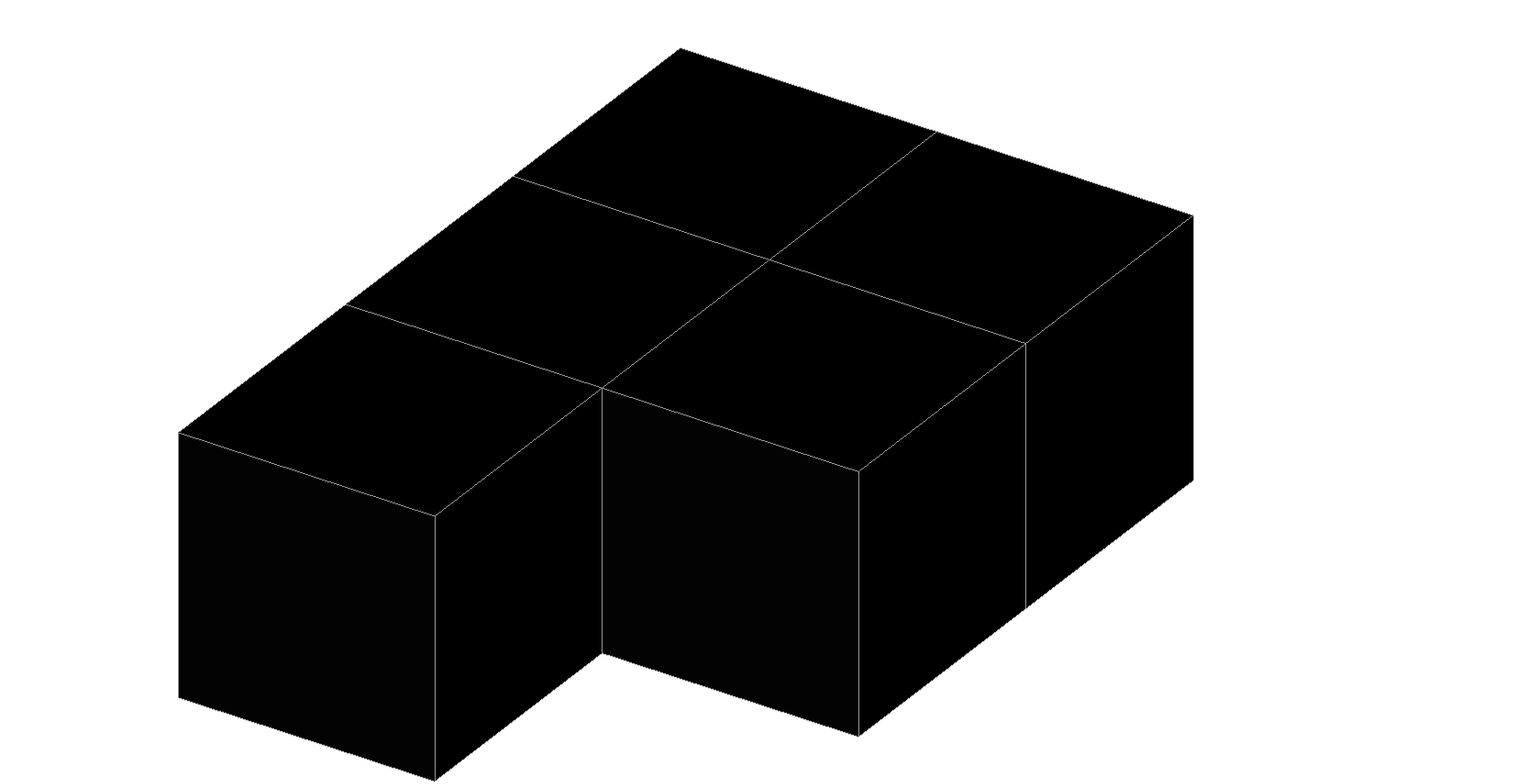
No. It is not possible to build this shape.
There is no Soma block that contains 5 unit cubes. What about joining two Soma blocks?
A shape containing 5 cubes can not be built by joining two Soma blocks.
After attempting to build the given shapes, you should have also realized that it is not possible to build shapes that contain 3 or 4 unit cubes other than the Soma blocks in the Soma Set.
Identify the number of cubes in shapes that are impossible to build with a Soma set.
Have you realize that it is not possible to build any shape that contains the following total number of unit cubes.These total number are
1, 2, 4, 5, 6, 9, 10, 13, 17, 18, 21, 22, 25, and 26. Furthermore, any shape that requires more than 27 unit cubes could not be built.

Let N be the total number of unit cubes in any given shape.
Where
a represents the number of Soma blocks that contain 3 unit cubes and
b represents the number of Soma blocks that contain 4 unit cubes
For any given shape relationship of N,a and b could be given as,
N= 3a+4b
Where a ε {0,1} b= ε {0,1,2,3,4,5,6}
In words, a can only take value 0 or 1 and b can take value from 0 to 6.
You have learnt the counting cube techniques.
Let’s focus on the Soma Cube. It contains 8 vertices. There are 7 Soma blocks to make these 8 vertices.
Block number 1 could be used to form only one vertex of the Soma Cube.
When Soma block 1 makes one vertex, it cannot make another corner (vertex) in a Soma cube.
However, the block 1 could be placed within the cube in a manner such it does not make any corner (vertex).
The following provides the possible vertices each block could form.
 |
 |
 |
 |
 |
 |
 |
|
| Number of possible vertices | 0, 1 | 0, 1, 2 | 0, 2 | 0, 1 | 0, 1 | 0, 1 | 0, 1 |
Attempt to build a Soma cube in which Soma Block 3 makes only one vertex.
Soma block 3 can make zero or two vertices. If it does not make a vertex, all remaining blocks have to make 8 vertices. However, all other blocks can make at most 7 vertices. Therefore, Soma block 3 must form two vertices in any Soma cube.
Soma block 3 can make zero or two vertices. If it does not make a vertex, all remaining blocks have to make 8 vertices. However, all other blocks can make at most 7 vertices. Therefore, Soma block 3 must form two vertices in any Soma cube.
Likewise, the Soma cube could not built where Soma block 2 does not make any vertex.
If Soma block 2 makes one vertex, all other blocks must contribute to make the other 7 vertices.
Alternative Coloring is one of the Coloring techniques. See the pattern of a checker board.
See the pattern of a checker board.

Have you noticed the squares are alternatively colored with two different colors. In other words, each white square has black squares adjacent to it, similarly, every black square has adjacent white squares.
This coloring method is known as alternative coloring, and could be used to assist in proving impossibilities.
Before moving onto impossibility proof, let’s see how to apply alternative coloring techniques to individual Soma blocks.
In Chess boar or Checker Board, squares are alternatively colored. Here, individual cubes are colored instead of squares.

| Soma Blocks | Maximum number of white cubes |
|
2 |
|
2 |
|
3 |
|
2 |
|
2 |
|
2 |
|
3 |
Attempt to build a Soma cube that neither Soma Block 2 nor Soma Block 3 does not make any vertex.
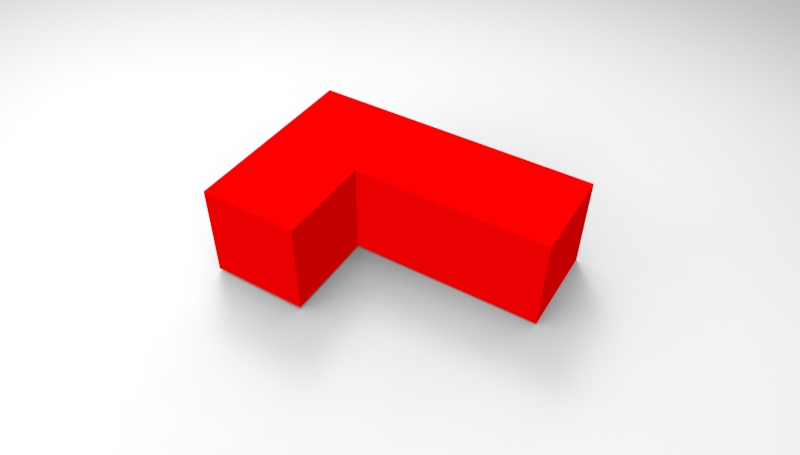
Alternatively, it is possible to color the cubes such that the maximum number of cubes is colored in black.
When a Soma block is coloured such that the maximum number of white cubes is obtained, the number of black color cubes becomes minimum since the sum of the black and white cubes is constant.
For your complete understanding, the following picture shows alternative colouring for both colors. Therefore, it depicts for each block the maximum number of white cubes as well as maximum number of black cubes.

There are 8 white cubes.

One of the possible number set is given in the following table.
| Soma block | # of white cubes | # of black cubes |
|
1 | 2 |
|
2 | 2 |
|
3 | 1 |
|
2 | 2 |
The number of white cubes in a shape cannot exceed the number of white cubes in the Soma blocks that builds the shape. In the previous example, the shape is built with Soma blocks 1, 2, 3 and 4.
Therefore, this shape passes the alternative coloring test. This is due to the total number of white cubes in the shape is equal or less than the total number of white cubes in the individual blocks that builds the shape.
Thus, it is not possible to say that building of this shape is impossible. Keep in mind that the alternative coloring technique does not guarantee the building of any shape. It only tells the impossibilities.
Suppose a shape contains more than 9 white cubes, then surely it can be said that it is not possible to build that shape with Soma blocks 1, 2, 3 and 4.
Similarly, it can be said that any shape that contains more than 15 white cubes cannot be built with a Soma set.
However, it is not correct to say that having less than 15 white cubes in a shape guarantees the building of that shape with a Soma set. In other words, there are many shapes that require less than 15 white cubes which cannot be built with a Soma set. Emphasizing this point, it can be said that what is considered here is proving impossibilities.
The test criteria discussed under coloring and counting techniques are known as a necessity condition. The necessary condition states that in order to build a shape, it is necessary to fulfill certain conditions. Without fulfilling these conditions, it is not possible to build the shape. Two necessary conditions to build the shape are discussed under cube counting technique and alternative colouring technique.
A collection of conditions are said to be sufficient if fulfilling these conditions guarantees the formation of the given shape.
The given shape given has 9 white cubes and 6 black cubes.
This fulfills the necessity conditions.
However, it is not possible to build this shape using the Soma set.
Therefore, it is said that the considered necessity condition is fulfilled but the sufficient conditions is not fulfilled.
The number of white cubes in a shape cannot exceed the number of white cubes in the Soma blocks that builds the shape. In the previous example, the shape is built with Soma blocks 1, 2, 3 and 4.
Straight coloring is another impossibility proof technique. In this case, the blocks and shapes are colored horizontally, vertically or perpendicular to the plane on which the blocks are kept.
The following diagram shows the possible combination of white and black cubes when the straight coloring technique is applied to Soma blocks. If the color one is black then the color two is white vice versa.
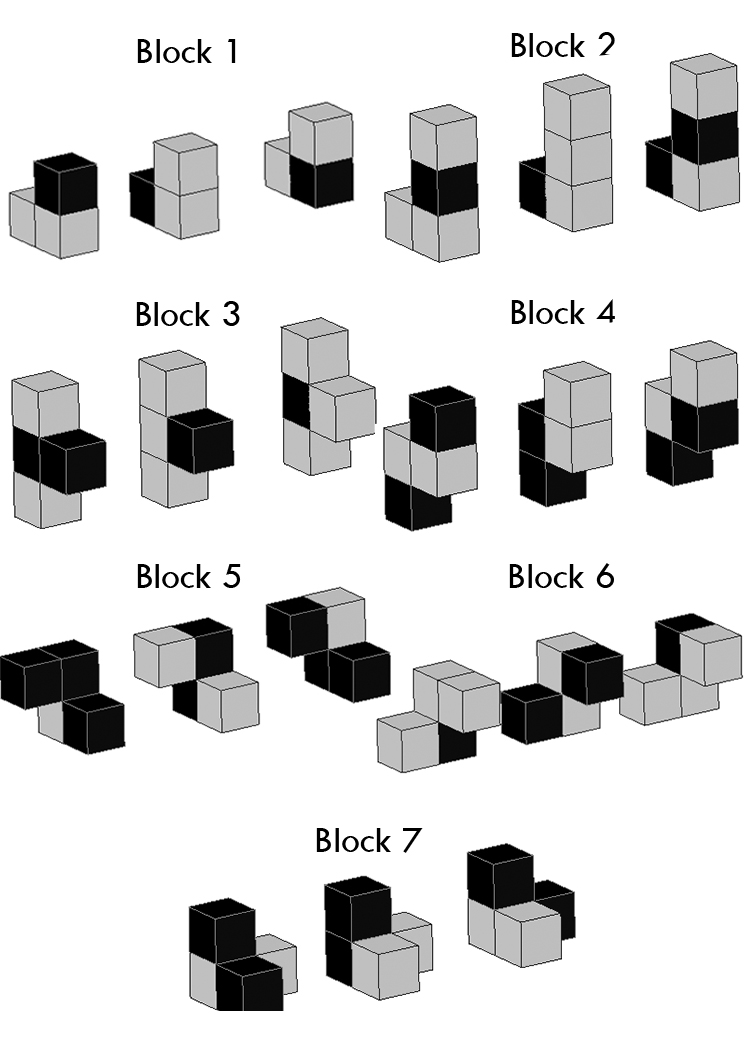
As shown in above diagram Soma block 2 can be coloured horizontally such that three white cubes are obtained. Colouring vertically also gives 3 white cubes. Colouring Perpendicularly gives 2 white cubes. These instances are given as possibility 1 and possibility 2 in the following table.
| Possibility 1 | Possibility 2 | |||
|---|---|---|---|---|
| Soma Block | White | Black | White | Black |
| 1 | 2 | 1 | ||
| 2 | 3 | 1 | 2 | 2 |
| 3 | 3 | 1 | 2 | 2 |
| 4 | 2 | 2 | ||
| 5 | 3 | 1 | 2 | 2 |
| 6 | 3 | 1 | 2 | 2 |
| 7 | 2 | 2 | ||
As shown in the figure, the maximum number of white cube obtained is 11. There are 4 black cubes.
Soma block 1,2,3 and 4 are the only candidate Soma blocks since others have more than one layer.
The table on possibilities tells that these four blocks have in total a maximum of 10 white cubes when horizontal coloring technique is applied. Therefore, it can be said that the given shape does not meet the necessity condition. Thus, forming that shape with Soma block 1,2,3, and 4 is not possible

It will be evident that the given shape pass the necessity condition required in cube counting and alternate coloring technique. However this shape fails the straight coloring technique. Therefore it can be said that building this shape is impossible.
Number grid is recording instrument. It can be used to record your progress in making Soma cubes and other shapes.
For Soma cubes, each Number Grid is a 3*3 matrix corresponding to 9 unit cubes in each layer. Hence, for every Soma Cube there are 3 Number Grids.
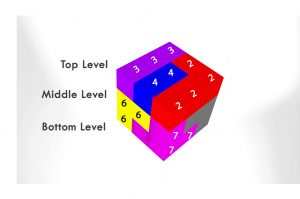
Top Level
| 3 | 3 | 3 |
| 4 | 4 | 2 |
| 2 | 2 | 2 |
Middle Level
| 6 | * | * |
| 6 | * | * |
| 7 | 1 | 1 |
Bottom Level
| 6 | * | * |
| 7 | * | * |
| 7 | 7 | 1 |
* Invisible
One is free to label the cube in a completely different way. However, the same labeling method should be followed thereafter.
In this site the Number Grids is read from left to right.
Top Level
| 3 | 3 | 3 |
| 4 | 4 | 2 |
| 2 | 2 | 2 |
Middle Level
| 6 | 3 | 5 |
| 6 | 4 | 4 |
| 7 | 1 | 1 |
Bottom Level
| 6 | 6 | 5 |
| 7 | 5 | 5 |
| 7 | 7 | 1 |
Answer
Top Level
| 3 | 3 | 3 |
| 6 | 6 | 5 |
| 4 | 4 | 5 |
Middle Level
| 6 | 3 | 2 |
| 6 | 5 | 5 |
| 7 | 4 | 4 |
Bottom Level
| 2 | 2 | 2 |
| 7 | 1 | 1 |
| 7 | 7 | 1 |
Answer
Top Level
| 3 | 6 | 4 |
| 6 | 6 | 7 |
| 2 | 2 | 7 |
Middle Level
| 3 | 6 | 4 |
| 3 | 5 | 4 |
| 2 | 1 | 7 |
Bottom Level
| 3 | 5 | 5 |
| 2 | 5 | 4 |
| 2 | 1 | 1 |
Answer
Top Level
| 3 | 3 | 3 |
| 1 | 1 | 4 |
| 2 | 2 | 2 |
Middle Level
| 7 | 3 | 5 |
| 1 | 6 | 4 |
| 2 | 6 | 4 |
Bottom Level
| 7 | 7 | 5 |
| 7 | 5 | 5 |
| 6 | 6 | 4 |
Answer
Soma blocks and cubes could be represented in the binary number system.
First learn how we could represent the 7 Soma blocks in the binary number system. Table 7 provides the binary representation for each block.
| Soma Blcok in Decimal | Block in Binary |
|---|---|
| 1 | 001 |
| 2 | 010 |
| 3 | 011 |
| 4 | 100 |
| 5 | 101 |
| 6 | 110 |
| 7 | 111 |
In a Soma cube, there are three layers each with nine unit cubes. These nine positions and three layers can be represented in a matrix form.
If a particular block resides in a position on a layer, those positions are marked as one (1). If none of the position is occupied by a cube, these positions are marked as zero(0).
The following table shows the position of Soma block 1. The three unit cubes resides on 3 places out of 9.

| 1 | 0 | 1 |
| 1 | 1 | 0 |
| 0 | 0 | 0 |
The following table presents a built Soma cube in a binary numbering system. This table contains 7 columns and 3 rows.
| Seven Soma Blocks in Binary format | |||||||||||||||||||||
|---|---|---|---|---|---|---|---|---|---|---|---|---|---|---|---|---|---|---|---|---|---|
| 001 | 010 | 011 | 100 | 101 | 110 | 111 | |||||||||||||||
| Bottom Layer | |||||||||||||||||||||
| 0 | 0 | 0 | 0 | 0 | 0 | 0 | 0 | 0 | 0 | 0 | 0 | 0 | 0 | 1 | 1 | 1 | 0 | 0 | 0 | 0 | Back row |
| 0 | 0 | 0 | 0 | 0 | 0 | 0 | 0 | 0 | 0 | 0 | 0 | 0 | 1 | 1 | 0 | 0 | 0 | 1 | 0 | 0 | Middle row |
| 0 | 0 | 1 | 0 | 0 | 0 | 0 | 0 | 0 | 0 | 0 | 0 | 0 | 0 | 0 | 0 | 0 | 0 | 1 | 1 | 0 | Front row |
| Middle Layer | |||||||||||||||||||||
| 0 | 0 | 0 | 0 | 0 | 0 | 1 | 1 | 1 | 0 | 0 | 0 | 0 | 0 | 0 | 0 | 0 | 0 | 0 | 0 | 0 | Back row |
| 0 | 0 | 0 | 0 | 0 | 0 | 0 | 0 | 0 | 0 | 1 | 1 | 0 | 0 | 0 | 0 | 0 | 0 | 0 | 0 | 0 | Middle row |
| 0 | 1 | 1 | 0 | 0 | 0 | 0 | 0 | 0 | 0 | 0 | 0 | 0 | 0 | 0 | 0 | 0 | 0 | 1 | 0 | 0 | Front row |
| Middle Layer | |||||||||||||||||||||
| 0 | 0 | 0 | 0 | 0 | 0 | 1 | 1 | 1 | 0 | 0 | 0 | 0 | 0 | 0 | 0 | 0 | 0 | 0 | 0 | 0 | Back row |
| 0 | 0 | 0 | 0 | 0 | 1 | 0 | 0 | 0 | 1 | 1 | 0 | 0 | 0 | 0 | 0 | 0 | 0 | 0 | 0 | 0 | Middle row |
| 0 | 0 | 0 | 1 | 1 | 1 | 0 | 0 | 0 | 0 | 0 | 0 | 0 | 0 | 0 | 0 | 0 | 0 | 0 | 0 | 0 | Front row |
| Bottom Layer | Middle Layer | Top Layer | ||||||
|---|---|---|---|---|---|---|---|---|
| 1 | 1 | 1 | 1 | 1 | 1 | 1 | 1 | 1 |
| 1 | 1 | 1 | 1 | 1 | 1 | 1 | 1 | 1 |
| 1 | 1 | 1 | 1 | 1 | 1 | 1 | 1 | 1 |
Instead of 1, if you get either 0 or a number greater than 1, it means either position is not occupied or more than one cube occupies that position. These two instances do not make Soma cube. Therefore, it can be said this is a sufficient condition to make a Soma cube.
One of the limitations of the above method is that a column can be replaced with another one in such a way that the necessary condition is fulfilled but it is not sufficient to make a Soma cube.
Another way of representing a Soma cube or shape is to use the Cartesian coordinate system.
In presenting a Soma block in Cartesian coordinate system, triplets of the integers are used.
A triplet is a set of 3 digits corresponding to X,Y,Z coordinate positions of a unit cube.
Three triplets are used to represent Soma block 1 and four triplets are used to represent the other 6 soma blocks.
Notice that the last digit of all the triplets is 0. This indicates there is no distance along the Z axis. In other words, these triplets represent unit cubes on the bottom layer. All the unit cubes on the second layer (one above the ground layer) have integer 1 as the last digit of every triplet.
Notice that when a block is kept on the XY plane, Z value is zero.
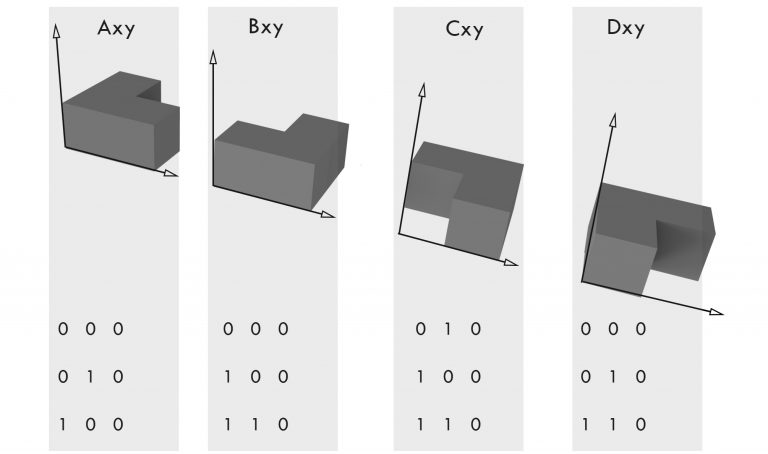
The Soma block 1 lies on XY plane. It can be also kept on YZ, and XZ planes.
The positions on the YZ plane can be derived by replacing X’s position with Z’s, Y’s position with X’s position, and Z’s position with Y’s position. In this case, values in the X plane become zero.
| XY Plane | YZ plane | XZ plane |
|---|---|---|
| 000 001 010 | 000 001 010 | 000 100 001 |
How do you represent the unit cube at the opposite end of the diagonal from the origin. This cube is shown in black in the figure on your right?This can be represented as 222

Have you noticed that Soma block 1 can be placed in 144 ways in the Soma cube.
Identify how many different ways in which other Soma blocks could be placed in a Soma cube. Compare your answer with the following table.
144
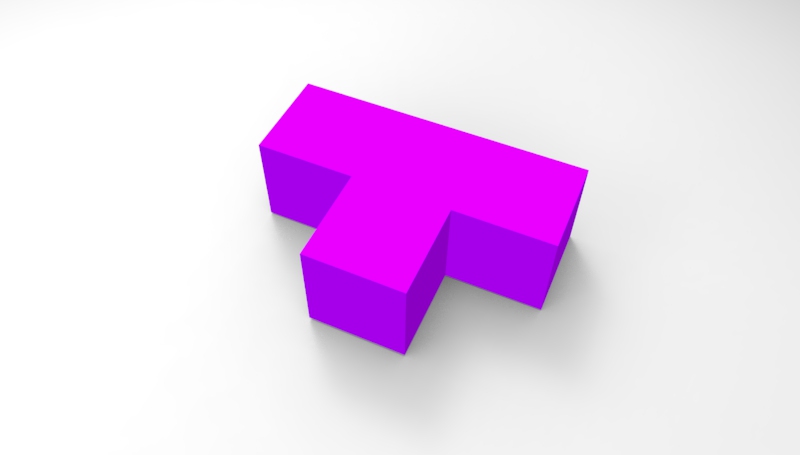
72

72
96
96

64